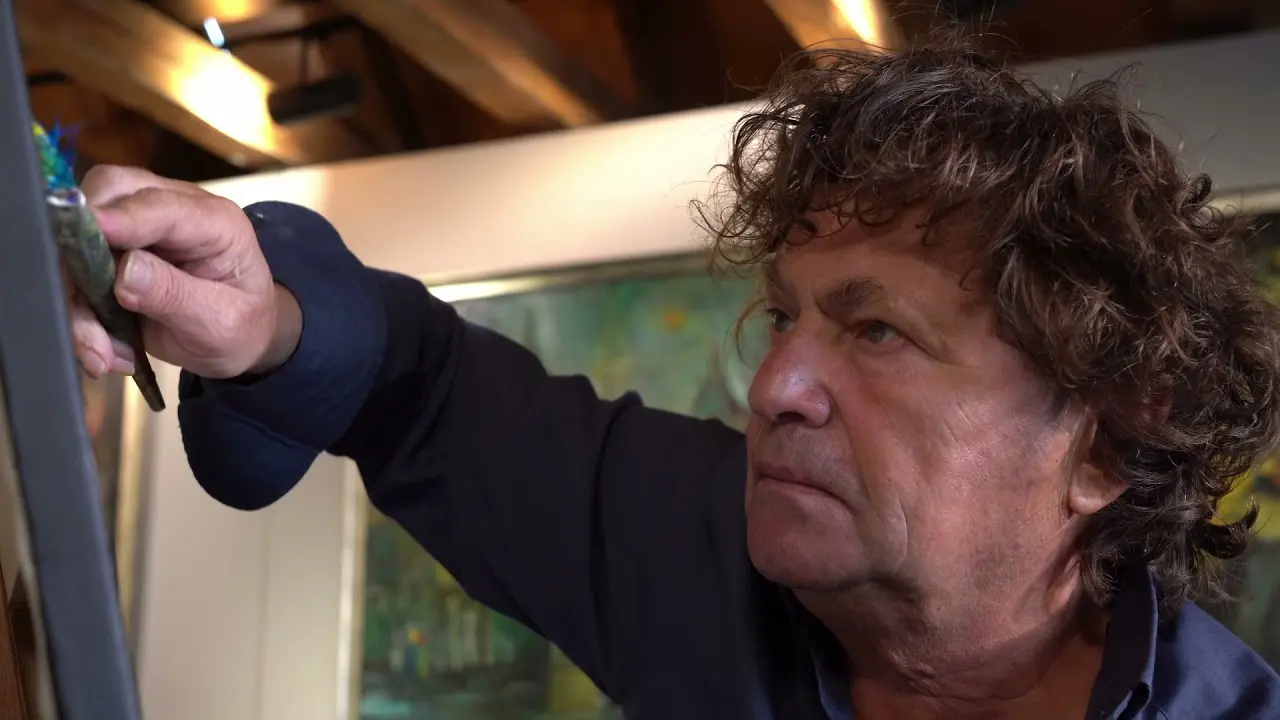
I do not know who I am, but in all my finest dreams, ever since childhood, I dreamed of being a painter
I was born in Luduș on August 13, 1953. My father, a railway traffic dispatcher, possessed such an exquisite handwriting that even the typewriters of the era could have learned much from him. His talent for drawing and, above all, for calligraphy manifested itself between 1956 and 1964 within the communist prisons, where he would copy poems onto the wooden soles of shoes.
My first encounter with painting and with the countenance of God came early. I was about three years old when I went with my grandmother to church, to pray that God would bring my father back. In those years, I filled my eyes and my soul with the icons painted on the walls of the hilltop church, where I created my first works at just six years of age. By the age of nine, I was visiting the art museums of Transylvania. In Cluj, I discovered the masters of Romanian painting – Grigorescu, Luchian, Andreescu. In Sibiu, I encountered those of the wider world – Rembrandt, El Greco. Andreescu bestowed upon me melancholy, while El Greco imparted the dream of ascension, of overcoming sin through Art and Love – the dream of Redemption. Both remained forever in my soul as masters of Eternity. When I became capable of understanding them, I became a painter.
The school years and those spent at the “Ion Andreescu” Institute of Art merged like a sunflower at the end of summer, leaving in place of golden, youthful petals the russet hue of harvested wheat. The colors of autumn have always fascinated me; its nuances offered me the serene, silent fulfillment of the harvest – yet also the dread of withering too soon, of detaching from the branch before my time.
Everything within me burned then: joy and sorrow, sadness and happiness. All of them lasted a second or an eternity. The season of my first white shirt arrived when I stepped out into society – apprehensive, deeply moved, and joyful, like an apprentice aspiring to become a master. This took place in 1973, at the gallery of the Institute of Medicine in Cluj, where I held my first solo painting exhibition. Thereafter, my exhibitions followed one another like consecutive autumn rains. The sunshine between two downpours filled my studio with canvases and compelled me to find a place for them in the souls and homes of the people for whom they were painted. They were no longer mere objects, but burning fragments of my soul, born to be carried within the spirit. Then I understood the profound meaning of these words: “For You are He who offers and He who is offered, He who receives and He who is distributed, Christ our God.”
December 1989 arrived, and I was in Timișoara. Our city evoked the vision and counsel of El Greco: God had descended into the midst of the city and its people, saving us. Tragically, He claimed the most innocent, those who revered Him, those liberated to soar toward eternity. We remember them each December, and their martyrdom was not in vain.
In early January 1990, I painted monumental canvases and wooden panels directly in front of the Cathedral, in the tracks of the tanks and the crushed bodies of the youth. These paintings remained there for months – they were no longer solely mine. They formed an altar for those pardoned for the sake of freedom, for those who departed from our midst far too soon. Alongside a circle of writers and poets, I co-founded Timișoara, the city’s first free newspaper – a symbol of hope and salvation.
It was the decade in which I first left the country, when I visited the great museums of the world and exhibited in numerous halls and institutions:
The Netherlands (1992) – Amsterdam City Hall, Rotterdam, The Hague; France (1994 and 1999) – the Museum of the Basilica of Notre-Dame de Fourvière and the Palace of Justice in Lyon, at the invitation of the city’s mayor and Cardinal Albert Decourtray; Germany (1990–2000) – over twenty exhibitions organized in Freiburg, Mannheim, Heidelberg, Munich, Berlin, and other cities, at the invitation of cultural foundations and prestigious universities; Poland – at the Monastery of Notre-Dame de Częstochowa; Hungary – in several galleries in Budapest and Szeged, as well as at the headquarters of the Romanian Cultural Institute and the Administrative Palace; Austria – at the headquarters of the Romanian Cultural Institute in Vienna; Luxembourg – at the “Le Cercle du Münster” Gallery; Belgium (2014) – at the headquarters of the European Parliament in Brussels; Canada – in the cities of Toronto and Montreal.
These were the exhibitions where I felt that the world belongs to everyone, and that Love and Art will always triumph.
Mihai Teodor Olteanu
 Exclusively Represented
Invest at the Source:
Collector's Circle
Not just a newsletter. Your backstage access.
Members receive notifications of artworks fresh off the easel, enjoying the privilege of acquiring at STUDIO PRICE, before their public listing in galleries.