
Bocșa was a small town… and I hope it will at least remain so, but in the madness of today, it is heading toward a hard-to-define status. It is quite close to the county capital, the city of Reșița, so over time, we had rather few artistic events in Bocșa. However, after I got married and until I emigrated to Germany, I participated in almost every event that took place. At first with my wife, Doinița, and later we were joined by both our children, Casiana and Claudio.
Several exhibitions were organized in the main hall of the Plant Club. It was there that I also met the painter Mihai Teodor Olteanu, who is ten days older than me!
The visual artist Mihai Teodor Olteanu was born in Luduș, in central Transylvania, on August 13, 1953.
I spoke with him, and he made a truly wonderful impression on me!
I asked him for an autograph, and the painter wrote to me:
“Art is a phenomenon so beloved and so necessary that, for me, it merges with life itself. With friendship, Mihai Th. Olteanu. Bocșa, November 24, 1983”
My impression of this autograph is that it reflects the artist’s respect for his work, for the person asking for his signature, and, equally, a mutual satisfaction for both parties.
I am glad to live in the computer age because I can verify an artist’s value and body of work, even if public perception often remains merely an… opinion.
Online, in a presentation of the painter Mihai Teodor Olteanu, I found a text that I share with great fondness, as it comes from a great artist addressing his fellow human beings:
“Everyone discusses my works and claims to understand them, as if it were necessary to understand them, when it is quite enough simply to love.
I do not know who I am, but in all my finest dreams, ever since childhood, I have dreamed of becoming a painter. And today, my most beautiful dreams and greatest desires remain the same: to become a painter. I shall never dream of anything more beautiful.”
And he became a Great Painter!
In the book “Tangents – Autographs and Their Stories,” I wrote about the painter Mihai Teodor Olteanu:
“When things of value are born from your hands, rising to the rank of art, you are pure within, and the soul is elevated…”
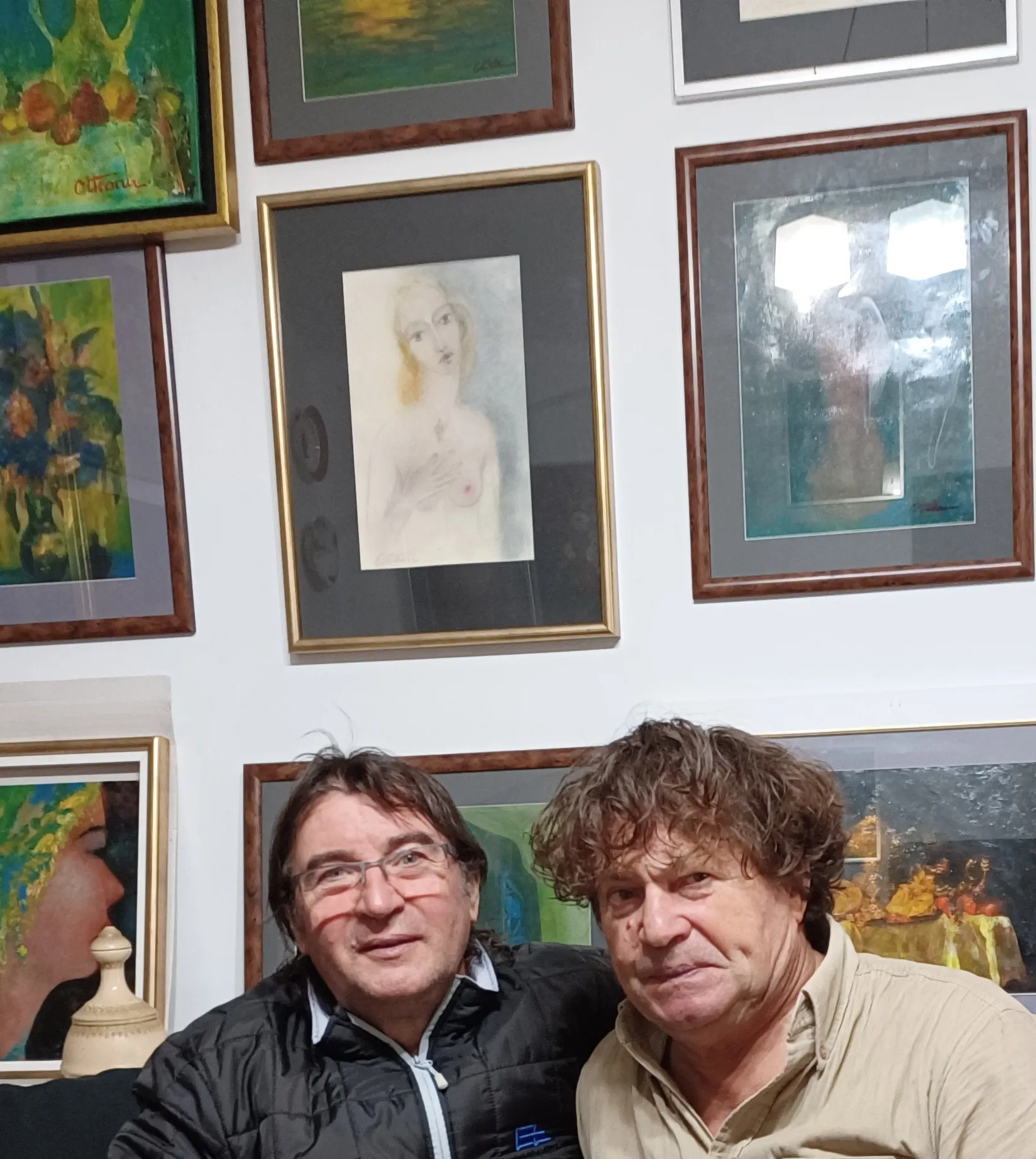
On September 21, 2022, I traveled by train to Timișoara. In front of the Opera House, I met my brother, Eugen, and together we visited the editorial office of the Timișoara publication, where we met Anton Borbely. Then I called the artist Mihai Teodor Olteanu and asked him if I could pay him a visit. His answer astonished me: he was waiting for me!
Our reunion was a truly wonderful story! I am still fascinated by that encounter… To meet again after 39 years and have the joy be as if we had seen each other every week… There are people you meet just once and feel as though you have known them since the beginning of time. We met again after all those years, and the emotion, the joy, and the curiosity were overwhelming!
The artist has remained the same: profound, passionate, authentic. He has evolved upon the scale of virtues, becoming an accomplished professional, a lover of beauty, of his fellow human beings, and of Good God!
Dear Mihai, dear Master, I respect you for everything you do!
To my great delight, I conducted an interview with a truly great painter and an extraordinary man!
Adalbert Gyuris
Interview
Adalbert Gyuris: I was reading about you, and you mentioned at one point that the saints and angels painted in the church of your native village inspired you to take up painting. Was there anyone in your family with an inclination toward drawing, and how did your sensibility for painting first awaken?
Mihai Teodor Olteanu: It was around 1956 when the blue-eyed boys—the grandfathers of today—arrested my father, locked him in the Securitate cellar, and kept him there for at least six months until he was tried by the military tribunal in Cluj. They sentenced him to nine years of hard labor for the crime of concealment—a crime of high concealment… In truth, he had done nothing wrong; simply serving as a stationmaster in Luduș, he had come into contact with Hungarian intellectuals who shared with him what they intended to do in Hungary: to expel the Russians who had imposed a communist, or socialist, or at any rate communist-derived regime. He knew these things and, naturally, had also shared those fears with others at the railway station. They condemned him to nine years. He refused to confess that his colleagues also knew, so everyone else remained free except him. One of his dearest friends, a priest named Ioan Oroșan, took me under his wing and gave me many small photographs of icons to copy. That was my first encounter with drawing, with color, with painting, and with the great mysteries of the world…
Long after my father returned—and throughout a childhood where I prayed every day to God for his return—the Church became my second home, alongside my grandmother, who took me there. I would gaze upon the Saints and the Icons inside the Red Church, the upper church, the Romanian Orthodox church in Luduș—a sanctuary I visited with all my heart and unwavering faith, believing that one day I would find my father there. Indeed, it was this very faith that brought him back; it was this faith that gave me the endurance to wait for him so long. After we were reunited, I realized that he possessed a golden handwriting and an astonishing gift for drawing, qualities that I later found fully embodied in the architectural craft of building a home.
The communists had taken absolutely everything from us and forcibly relocated us into dwellings that resembled stables—houses with dirt floors and an outhouse at the end of the garden… That was the punishment inflicted upon me when I was three years old, while my father served nearly the entirety of his nine-year sentence because he refused to cause harm to anyone, not even to his colleagues who had heard the accounts told by the Hungarians at the Luduș railway station.
Adalbert Gyuris: Does a piece require a great deal of time, or does it begin primarily with the idea, the sketch? When you are working on a piece, does it depend on the technique used, the scale, or are there other factors involved?
Mihai Teodor Olteanu: The labor poured into a canvas, a painting, a drawing, or anything concerning the plastic arts defies measurement in time. Time is merely a current flowing in, out, or through the work. For a visual artist, the paramount element is the inner state they enter upon encountering a pictorial motif. These motifs take root from nature—from the creation of God, the supreme painter of the universe—and settle within the artist’s soul, only to be reconfigured through the eye and mind onto the sheet of paper or the canvas resting on the easel. The duration of the work is inconsequential; what truly matters is the depth of soul invested, the fidelity of the emotion rendered, and the resonance received from the envisioned image. This emotion transforms into your inner turbulence, your disquiet, becoming the very motif you paint—not the literal motif of reality, nor the initial spark of inspiration, but the overarching idea that this motif will evoke within the viewer’s soul, eyes, and heart a state of emotion far more intense than the one you experienced upon first confronting it. For the world’s master painters, pictorial motifs are not numbered in the hundreds. They comprise a strictly limited corpus, predominantly bound to life, death, and devotion. Almost all great masters have encountered, at some point in their lives, a defining motif, a singular state or event that channeled their entire existence and oeuvre along a singular trajectory. Here, I would name Andreescu, one of the first painters I discovered in museums, whose work radiates a profound melancholy and a relentless spirit of inquiry and turmoil. And another is Vincent van Gogh, whose vision parallels certain aspects of Andreescu’s oeuvre, yet is consumed and incinerated by an even fiercer fire…
One of them nurtured my childhood, while the other gladdened my adolescent years. Both are painters of eternity; both are artists for whom lived reality and the inner anguish stored within their hearts served as a beacon, illuminating the path to painting, the path of creation. One cannot paint without being driven by an inner compulsion, without the profound awareness that you are bestowing a gift—and that this gift uplifts humanity, transforms people for the better, and in turn inspires them to give.
Adalbert Gyuris: In a remarkably crafted film directed by Vasile Bogdan, with cinematography and editing by Grațian Gâldău, I observed a technique of yours that your professors most certainly never taught you. Therefore, I must ask: does contemporary artistic practice differ from the past, from the methods you studied at the institute?
Mihai Teodor Olteanu: You are referring to the film directed by Vasile Bogdan and Grațian Gâldău, „The Light of the Angels. Divine Gift,” a piece running approximately half an hour, filmed within one of the most magnificent galleries that has repeatedly housed my works: the attic space of the National Museum of the Banat. It is a gallery that, almost every autumn, transforms across time into my studio for a month—a space for public engagement, meditation, and spiritual elevation. Up there in the loft, where light streams through the windows of a vast hall, a colossal cupola rests upon hundreds upon hundreds of beams, resembling shoots, trees, and branches rising from the earth to uphold the sky. Within this space, I invariably exhibit around one hundred works, welcoming schools, high schools, and children who come face-to-face with my painting and are permitted to touch it. For every work of art is a fragment of the soul; the more it is loved, caressed, and cherished, the more it flourishes, bestowing itself ever further and penetrating more effortlessly into the hearts, souls, and homes of those who will delight in it. This film, captured live over thirty minutes, depicts an act of painting directly before the camera—the rendering and unfolding of a floral pictorial motif discovered instantaneously, yet sought after throughout my entire life: a flower, a bouquet of blossoms born to warm the soul, emerging from the confluence of multiple worlds…
Flowers, much like angels and women, are beings that dwell within your soul and bring you boundless joy. Never should a true artist, a true painter, feel the need to step outside their chamber in search of a motif. The motif resides within the confines of their chamber, their heart, their soul. To paint a bouquet of flowers, a vase of blossoms, or even the slender stem of a single flower is to paint joy and happiness as a gift—imbued with that persistent disquiet that accompanies the artist from their earliest canvases to their very last. It is a restlessness they possess and never betray, provided their art remains true to its destiny and succeeds, at least once a year, in bringing joy to someone. If, among the hundreds of canvases painted in half a year, a single year, or a decade, a fraction succeed in giving solace, in consuming souls, in healing them from the malice of the world, then your entire oeuvre is blessed, healing, and supreme.
A true painter is discovered not only in their paintings, but equally in their relationship with the other arts, for plastic art is an art of assimilation and sedimentation. Painting is not merely the application of color to canvas, but the enfolding onto or into the vast canvas of life, of the world, of all the hues that abide within you and your world, subsequently shared with those around you. To be a painter of souls is to be an actor—to enact one’s own role upon the stage of the world, upon a boundless stage where you author your own role far more completely than the actor who assumes diverse parts while always believing himself to be merely himself. The painter is even more than an actor, for no one writes their script, no one directs their paintings; only they, only their tempestuous soul—a soul embraced by others—fashions their destiny, their life, and their eternity. If an artist’s paintings fail to evoke emotion, they remain mere objects to be hung upon the walls of galleries and museums across the world. The paintings of a true artist evoke emotions; they do not merely hang upon nails, but remain forever etched into hearts. Only then does a painting endure for all eternity, ensuring that its creator never truly dies, but is remembered by generation after generation, perhaps even long after their physical lifetime. For the subjects that bring the artist before the viewer are neither copied nor stolen from museums or folios, but are profoundly lived by the artist. Their subjects are not sought in desperation; they have been and remain the subjects of all the great painters of the world. Never has man, woman, flower, angel, or the visage of Christ needed to be hunted down by the artist. These are the subjects the true artist encounters from childhood until their final canvas—encountered everywhere without ever seeking them, without ever thrusting them onto the canvas with ostentation. They resided deep within, brought to the surface solely to reveal to those around us the sublime vision of the one who taught us all how to paint. Yet we are not destined to copy him, but rather to contribute a fragment, a fleeting moment, a glimmer of our own personality to his universal tapestry, believing, if only for a second, that we too might become painters.
Adalbert Gyuris: In your view, what constitutes the difference between an amateur and a professional?
Mihai Teodor Olteanu: I do not believe that an artist’s formal training is the dominant force; I do not believe that painting or the fine arts are created by professors. You learn from professors, as we discussed earlier, yet your Maker is the greatest painter in the world—He painted the universe the moment He bestowed it upon you, upon all of humanity. He thought of you, He thought of the artist within you, knowing you would be infinitely poorer if you failed to discover all the beauties of the world, arranged after His own image and likeness. You stepped into this world as if into an amphitheater, onto a stage where you lacked nothing; and whenever you felt that certain things fell short of your dreams, your visions, your desires, you did nothing else than set to work, shaping them according to your own measure, your own liberty, your own joy. This does not mean you undertook the Genesis anew or remade the world. It means you added a touch of color to what He brought into existence. You applied a drop of color wherever you found yourself more vacant, where you saw yourself more faded, where you believed you had too little light, too little hue—too pale, too washed out, too shadowed. There you arrived with your own color, drawn from the universal palette of the world and humanity, spread it upon your modest canvas, and attempted to inscribe the letters of your own name upon it. The moment you realized that the first narrative—the first narrative of your colors meeting upon your small canvas—satisfied you, then you began to become your own master-painter, the chronicler of your own universe, transforming yourself into that which you consciously knew would lift you above the crowd and grant you a distinct renown: the chronicler of your own world, and a painter for posterity. For to be a painter does not merely denote the act of coating walls; rather, to be a painter means to render visions, to adorn surfaces in a profound new way, to portray worlds, to capture vistas that you perceive, transpose, and restate for your audience with that singular innocence and unmistakable signature. Among a hundred artists, the very same motif is painted in a hundred distinct ways, even if our eyes perceive it similarly, even if the photographs of those hundred artists appear virtually identical. That motif, or any motif, signifies something entirely different to each of us; it evokes another state of being, another conviction, another reception of existence, and to every single motif your personality will respond with something uniquely your own. This is the essence of the painter; this is his originality. You do not need hundreds of motifs in your panoply, nor must you hunt for unknown motifs never before beheld by anyone to be considered original. The exact same motifs contemplated by a hundred artists can endure as the eternal subjects of painting. And as I have said, the angel, the woman, and the flower are motifs that substitute one another, dwelling within one another across millennia upon millennia. You simply need to seek them out, to behold them, knowing that the attributes of one or another motif are subsumed in all; you will find them in everything—you merely have to search. This is what both the academically trained painter and the artist endowed with divine grace accomplish. They achieve this not through schooling, but through the grace bestowed upon them; and in doing so, their grace does not dissolve, nor is it destroyed—their grace endures, passing onward to successive generations, compelling others not necessarily to love him, but at the very least to remember him. And for an artist, love and remembrance are nearly synonymous. The great artists of the world who have entered the annals of global art history achieved immortality because they approached the exact same motifs and the exact same quests from beginning to end, yet they bestowed upon those motifs and quests a different form, a different countenance. This specific form, countenance, and light defined them, set them apart, and separated those whose works remained frozen in their own time—even if they amassed sacks or cartloads of wealth—from those who traversed the centuries, passing from one age into the very heart of our being to flourish and endure. Some of them—and I care not to name examples—are today more deeply cherished, more valuable, and more eternal than at the moment when they placed their lives, their hearts, their souls, and the grace granted by God into the service of the arts, thereby achieving eternity. And as time progresses, the more we seek them out, the more personal narratives we uncover that keep them vibrantly alive even today.
Adalbert Gyuris: What does art, and painting in particular, represent to you?
Mihai Teodor Olteanu: In the beginning, painting was simply a state of liberation for me, a state of transition from waiting for one kind of life into another life. That childhood devoid of a father’s presence, devoid of the figure whom—being so tender in years—I placed at the very forefront, doing so through the Church and the wisdom of my grandmother, I cast as a reason for hope. Back then, copying an icon or a drawing meant an encounter with myself and with my future destiny. It wasn’t about art; it wasn’t about anything extraordinary. Yet it represented a desire to press forward, to search, and to free myself from anguish, from the lingering dread that tomorrow I would still be alone. In fact, this pursuit of painting, of art, led me on a quest for destiny, for wisdom, for forgiveness, and for all those sentiments that draw humanity closer to the Divine. The Church was a second home to me; I would go inside, gaze upon the faces of the angels and the saints, and harbor the distinct feeling that they truly lived there, that they spent their eternity within those walls, and that their lives unfolded deep inside the masonry—and that sometimes they needed peace, serenity, and sacred solitude. At times, upon hearing the choir—being a child of three, four, or five—when the singing swelled too loudly, I had the distinct impression that it would startle the angels, disturb them, waking them from their slumber sooner than they might have wished. And I would look at the choir, look at the priest, wondering why he did nothing to stop the “noise” inside the church. In truth, the “noise” was not noise at all, but music, and the angels loved this music; moreover, this very music poured forth from the very walls where they were painted, where I believed they lay sleeping. It was then that I realized art can redeem you, that art can heal you, and that true art—like painting itself—is a creation meant to soothe the world, to shield it from evil, emptiness, warfare, famine, squalor, and deceit. Art springs from pure souls and holds no greater purpose than that of healing and salvation, much like the light with which God bonded when He first began to fashion the world, saying, “Let there be light,” and there was light. Within that light resided, resides, and will forever reside all the color of paintings, for no painting created with any pigment can exist without light. Light radiates from every convergence of colors; light redeems every hue as it overlaps, as it meets, as it unites with another. Between two joined colors, there is no war. None of the great colors of the spectrum can ever clash with another; none seeks to harm its neighbor, but rather seeks only to conjugate with it, to meet it, and to be enriched by it. Two colors that intersect give birth to a third, or to thousands upon thousands of nuances, because light is so universal at the core of a color that it can cause that color to iridescently shimmer in myriad shades. You must be prepared; your eyes must be ready to behold them, yet we do not see with our eyes alone—we see with our heart, our soul, and all our senses. Color, much like the word, is one of the great mysteries. To seek light, to seek color, and to seek the word is identical to giving light, giving color, and giving the word—and the artist does all of these things at once.
Adalbert Gyuris: Have you discovered anything through painting?
Mihai Teodor Olteanu: I do not believe that making painting is a matter of finding something significant through it, nor do I believe it matters whether one does or does not. The moment a painter advances with their art, they advance solely because they cannot turn back; true art impels you to where it is needed, when it is needed, and when you feel that it is healing, that it is redemptive. The moment you realize that you are not needed, that your painting is not needed, that what it is capable of doing is not needed, you will stop of your own accord because you will grow weary; you will realize that your art holds no meaning, no purpose, and you will not continue—you will stop naturally, as I said. But the moment you see a child pause before an easel bearing one of your works—a child who enters an art gallery or a museum where you have exhibited your canvases, filled with wonder and awe—your art must press onward. For to make a child marvel, to make them start, to awaken a sense of wonder, of delight, of joy, to make them feel something they had not felt a minute before encountering your painting, gives you the profound sense that you must go on, that you must not stop, and if you do, you do so with the joy you felt the very first time you painted. You never gain more through your art than you gained the moment you encountered it, the moment you realized you would find yourself, that you would stretch across an ever-broader surface of life, rediscovering yourself and meeting it—art, which at some point becomes your only way of living, at some point becomes your very life, with nothing standing above it, nothing more important than it. Your communication with the world from that point onward has happened, is happening, and will happen through what you accomplish via your art, through what you bestow via painting. You must never expect to be given back what you have given, for the very gaze of a child, the very wonder of a child before one of your canvases, has given you almost everything. You no longer need reviews, you no longer need art critics, you no longer need museums and libraries filled with writings and inscriptions about your art. You only need the wonder in a child’s eyes. That felicitous encounter with a child’s eyes, with the canvas superimposed upon the child’s gaze, with their eyes bathing in your painting—between those eyes and the canvas a sea is born, a body of water is born, a flowing river that will carry onward both their eyes and your painting. These two intertwined things, or more than two, shall be your impetus and your desire never to stop. For the moment you have captured a child’s eyes, the moment your canvas has been loved by those eyes and through them you have entered the child’s soul, granting them joy, gladness, a flicker of light, the double of their own gaze—when they saw the light, the color, and the tremor of their own eyes reflected in your canvas—then your soul became one with theirs. Then your art found itself within the heart of a child, and from there it has passed and will always pass into the heart of another, and another, until the very end; yet at the end you will never feel that it is the end, for the moment you have gladdened thousands upon thousands of eyes, the end no longer arrives. You neither see nor feel the end anymore, and your passage beyond into the light of other centuries is already written, already prescribed, already a reality. That is where your art leads you, therein lies the significance of your art: in the boundless quest of those around you for something within your art, something first discovered by the eyes of the first child, which his eyes carried forward into his own soul and the souls of those around him. Never, by any means, can anything other than creation ennoble, enrich, lift toward the heavens, or elevate into remembrance. For the remembrance of an artist is their immortality.
Adalbert Gyuris: Are you satisfied with what you are doing now? What would motivate you to change something?
Mihai Teodor Olteanu: The sentiment of fulfillment is a feeling sometimes so dear, yet at times so terrifying, because contentment can lead you to an overweening confidence, to an excessive jubilation, to a too profound encounter with yourself, the chosen one. This complacency can cause you to forget your genesis, to forget humility, to forget faith, and to drift from one end of the world to the other without caring any longer for the joy of those around you and the measure of that joy. I do not believe one should attach importance to your growth as an artist, to your artistic consummation. You must remain forever the novice, the beginner; your soul must possess the same tenor as when you first exhibited in a gallery, as when you first beheld an art critic, as when you saw your name in your first newspaper, or heard your words broadcast on radio or television, and upon hearing your words, someone smiled, someone rejoiced, someone perhaps broke into applause. This sentiment is sufficient to sustain you for a lifetime; this sentiment is enough to grant you the power and fortitude to press forward, to continue. An artist need not be perpetually acclaimed; an artist need not be constantly heralded for how grand or how significant he is. What is necessary is that such an artist be seen, that his canvases be contemplated and discussed, regardless of the words used. Paintings that are never discussed, never contemplated, whose existence remains unknown to the world—truly do not exist. A true artist must exhibit unceasingly. He must demonstrate to his public that his oeuvre is unfinished, that he has not yet painted the grandest, most exquisite, and most vital painting—which, for him, does not even exist. With each coming morrow in which he paints, his painting matures within him, takes root within hearts, and grows richer, more enduring, more substantial. It is neither the dimensions of a canvas, nor the gravity of a theme, nor the elegance of its framing, nor the place where it is hung that matters. Rather, it is the fact that when you announce an exhibition, and two, three, or five people attend the vernissage, rejoicing in your paintings, that is what matters to you. These people will return home happier—not because they heard words of praise for you, not because an art critic exalted you and, in exalting you, elevated you to a pedestal… It is not the critic, nor the radio, nor the television that will place you there, but rather the hearts you have entered, the homes where your paintings have been hung upon nails, driven with reverence in places where your gaze, the gaze of the master of the house, rests from the moment the door opens, from morning until night or from night until morning. The moment you possess a painting—or two, or three—within an intellectual’s home, paintings that engage in a silent dialogue, that converse and entwine their narrative with the stories of those who created the others, then you are truly alive, then your art lives, then the feeling that for a good long while you are not forgotten, for a good long while you remain unignored—this is what it means to be a painter; this means that your encounter with the public is taking place. As I have said before, you are the actor playing your own role; if the director comes and tells you to be silent and you stop, it means you never had a reason to begin in the first place. You have no cause to listen to a director, you have no way of heeding a screenwriter, you cannot obey the set designer who arranges your exhibition walls; you obey but a single thought, a single state of being—that you give because you have been forsaken.
Adalbert Gyuris: You have settled in Timișoara, having passed through other cities as well. Do you believe the place where you live aids you as a painter?
Mihai Teodor Olteanu: I spent my childhood in my hometown of Luduș. A town—or rather a commune back then—crossed by the Mureș River, nestled among hills, where at the foot of the first great hill stood three churches. That was the place where I went every Sunday with the hope and desire for a prayer, not for myself, not for my soul, not for my own joy; it was a prayer I always offered for my father, that I might see him, look upon him once more, and know the truth about him. Even now, I realize how my first teachers behaved and how they presented me to my classmates. How much pain they inflicted upon me, perhaps almost equal to the suffering and agonies of my father in prison. To present me as the son of a criminal was, to me, akin to a minor crucifixion, to having my hands and feet severed, to being branded with a stigma; yet I refused to believe the story told by my first teacher, and I tried with all my might to confront her and tell her that my father is and ever will be a pure man, an innocent man. I was right to believe this. Luduș then sent me to Cluj, to Târgu Mureș, to Sibiu, and other cities where I have exhibited… In Cluj, I completed my studies at the High School of Arts and subsequently at the Faculty of Arts. In Cluj, I met one of the great spiritual fathers of that place, who later became Bishop and Metropolitan of Cluj; this man began to resemble, more and more, the image of the father I had been waiting for. His name was Iustinian Chira Maramureșeanul, and he now rests at the Rohia Monastery. At all my exhibitions in Cluj, Bistrița, and Târgu Mureș, he would come and select works, purchasing pieces that I believe he later sent to his native village; I have never seen them since, but I know they are safely kept somewhere. Upon his departure from this earthly realm, I felt his soul misting over the glass of the casket… I do not know if I alone felt this, I do not know if it was merely a sentiment or actual reality, but whether it was or not, I know that one day that man will be proclaimed a saint of Transylvania. Then came my encounters with Târgu Mureș, Bistrița, and Timișoara. I came to Timișoara, and deeply desired to come here, because of my encounter with Deliu Petroiu, another pivotal figure in my life, a figure of the same stature as my father, an intellectual of the highest caliber—an intellectual who bestowed upon Timișoara and Arad boundless wisdom and joy, and who served as a spiritual father, a guide, a seeker, and even a conductor for visual artists on their journey toward harmony and the fulfillment of color. At our meeting in Cluj, Deliu Petroiu told me: “When you finish your studies, come to Timișoara, and I will take care of you.” I came to Timișoara, and he did take care of me! He ensured that dozens upon dozens of exhibitions were opened for me; he took care to speak with his characteristic wisdom and his profound ability to penetrate the hearts of the public. He was the most powerful orator in the realm of art criticism that I have ever encountered, and I have met not a few. He wrote little, he spoke enormously. He wrote little because his greatest joy was to witness the immediate reaction of the public, and books are not read in the presence of their author—books are read in solitude or in libraries, without the author being there. Through the power of his words, he wanted to feel the immediate reaction of the audience, and he wanted to draw you, the artist of whom he spoke—regardless of your school or training—directly into the public’s heart. He succeeded, perhaps with hundreds upon hundreds of artists; he achieved this not with hypocrisy, not with egoism, and not with the sentiment that he knew everything. He allowed you to be first, yet though the power of his words was astonishing, he never overshadowed you; rather, he superimposed himself upon your work so gracefully that not even you could have expressed or demonstrated more feeling in what you had created than he did. He lifted that entire burden from your shoulders and from the encounter with your public. Because merely by gazing upon your works, he began to feel what you had intended to say; he transposed himself into your heart, into your soul, searching for you beneath the layers of color on the canvas, within the painted sentiments or those intertwined in the enchantments of hue. You were there, inside the paintings, but he was the one who brought you forth and revealed you to the public through words. That is what the art critic Deliu Petroiu did. And he always succeeded! So many years have passed since he departed, and I do not know if anyone has taken his place. Timișoara has granted me the highest joys through the dozens and dozens of exhibitions where I brought my paintings—not for myself, not to show the public what I know or what I can do, nor to prove how great, sought-after, or beloved I am, but rather bringing them for him, for the public, to demonstrate that painting is a way for people to connect with one another, to draw closer, and to forget their troubles. Especially today, when the world has grown harsher than it once was, when people have begun to show one another that they do not care, that each can live alone and through their own strength—that is a great lie, a great delusion. None of us can live alone, because none of us were made, none of us were born of solitude; on the contrary, we were born from the merging of at least two great hearts, of two great loves. Their fusion led to our birth, and our birth was brought about by His great touch, by His great love, upon leaving which we also leave life. You can achieve nothing, whether rich or poor, without His love, without His mystery, and without His consent to consecrate you, to endow you, to send His light and His word for you to live. Every painting, every canvas, every spiritual achievement of yours is born from the light He placed in the midst of love, in the midst of solitudes, so that solitudes might meet, dissolve, and transform from isolation into fulfillment. Art cannot stand alone, restricted to a single side; it must reside within us and within those who gaze upon it. Between you as the artist and you as the viewer, there exists nothing save affection, love, and light, and Timișoara has bestowed this sentiment upon me from the very beginning down to the present day.
Adalbert Gyuris: Can people be educated through art? What must be done in this regard so that people may become better?
Mihai Teodor Olteanu: People are good and bad not because they wish to be, but because some have known how to choose goodness while others have stood aside, neither going to choose it nor waiting for it. The goodness in our hearts does not depend solely upon us, but also upon what is intertwined within us and what has been bestowed upon us from birth. In principle, all human beings have been endowed with light and love, and these two, linked together, should have moved forward toward our inner light, through goodness and through the return of these gifts of light and love. These two intertwined gifts make you better, make you more humane, make you resemble the One from whom you were born, the One from whom you received light and love. Yet sometimes human hypocrisy goes so far that one forgets where one came from, forgets why one came, and forgets whither one is going or where one shall return. This hypocrisy is born, at a certain point, from many, many triumphs of your own—triumphs and things you believe you have achieved by yourself, which you believe only you could have accomplished. In truth, they were bestowed upon you, given to you with a shyness and a delicacy that you were incapable of sensing as not being your own, as not belonging to you, but rather as having been given to you, bestowed upon you solely to shape you, to shape you in His image and likeness, so that nothing we possess personally can ever break free from His matrix, can ever transcend His matrix. We can be nothing more than His children, nothing more than His shadows and lights, provided we do not forget Him and do not cease to offer back to Him, for all our fulfillments are bound to His light and love, which we cannot squander, but must carry further, still through light and through love. By squandering these gifts of His, it is not Him we lose, but ourselves; we lose ourselves, and in losing ourselves we are somehow impoverished. To lose ourselves means that, lacking light and love, we are nothing more than mere shadows wandering the world in search of something… Art is what keeps you afloat and what shows you that you have no right to envy, to hate, or to be jealous of the gifts of others; on the contrary, you must love the one who seems better than you, love the one who appears to give more, and by loving them, you actually enter upon their path of self-giving.
Timișoara gave me this sentiment; the week of peace, of tranquility, and of encounter with the sublime in December 1989 made me believe that I belong forever to Timișoara and that this city will always illuminate me throughout my life and long after it.
Adalbert Gyuris: Dear Mihai, I wish you many joys, fulfillments, and that you may reach the place you deserve! I am convinced that you are on this well-trodden path and heading precisely where you belong!
Recorded with great affection and friendship by Adalbert Gyuris.
 Exclusively Represented
Invest at the Source:
Collector's Circle
Not just a newsletter. Your backstage access.
Members receive notifications of artworks fresh off the easel, enjoying the privilege of acquiring at STUDIO PRICE, before their public listing in galleries.