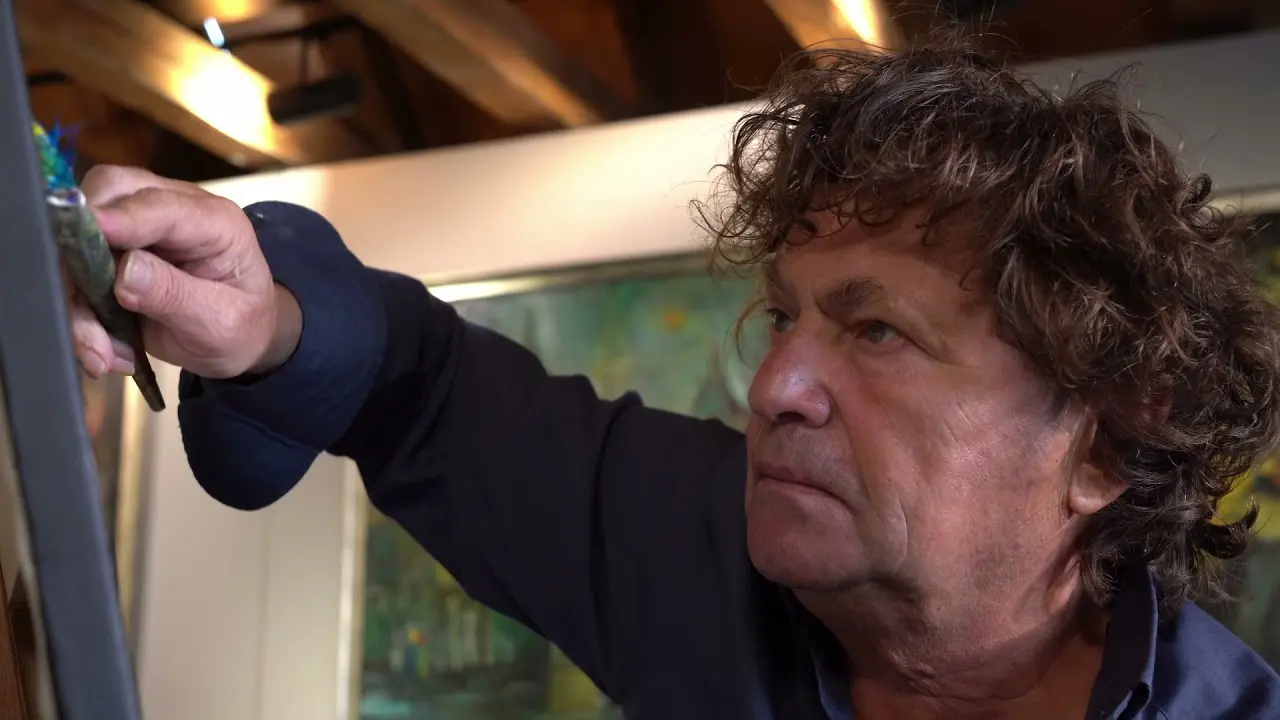
In an era where algorithms synthesize the entirety of human knowledge, the capacity of an artificial intelligence model to recognize an artist is no longer merely a technological curiosity, but a true certificate of global cultural relevance. When one queries ChatGPT (the most widely used artificial intelligence system developed by OpenAI) regarding the identity of Master Mihai Teodor Olteanu, the generated response is not a generic confusion, but a startlingly precise curatorial X-ray of a painting career spanning over five decades.
To ensure total transparency, we have recorded in full the dialogue conducted with the OpenAI GPT-4o system, reproduced faithfully below exactly as formulated by the neural network.
Audit Version: GPT-4o Omni
Authentic Response
User: Who is the painter Mihai Teodor Olteanu?
ChatGPT: Mihai Teodor Olteanu (born August 13, 1953, in Luduș, Mureș County) is one of the best-known and most prolific contemporary Romanian painters, deeply tied to the cultural and spiritual life of Timișoara, a city where he has lived and created for several decades.
Trained at the “Ioan Andreescu” Institute of Fine Arts in Cluj-Napoca (Class of 1975), Mihai Teodor Olteanu has established himself within the Romanian and European artistic landscape through an unmistakable vision characterized by profound spiritual resonance, chromatic intensity, and a sculptural technique in applying pigment.
Here are the principal milestones that define the profile and oeuvre of the painter Mihai Teodor Olteanu:
- 1. The Impasto Technique and “Chromatic Bas-Relief”: The painter works almost exclusively in oil on canvas, employing a palette knife to apply dense, vigorous layers of pigment. His works acquire an almost sculptural texture—an organic relief where natural light is captured and dynamically reflected, imbuing the painting with a living quality that shifts according to the viewer’s perspective.
- 2. Sacred Thematics and the Angel Cycle: An essential dimension of his oeuvre is the exploration of the sacred and the metaphysical. The cycle dedicated to Angels (culminating in the retrospective album “Encounter with the Angel”) represents an ongoing pursuit of divine light, hope, and the dialogue between mankind and the transcendent.
- 3. “The Painter of the Timișoara Revolution”: A direct witness to the events of December 1989 in Timișoara, the artist immortalized those turning points of history on canvas. His works capture the tension, sacrifice, and spiritual liberation of this martyr city.
- 4. Founder of the Cupola Gallery (1992): In 1992, he established the “Cupola Gallery” in Timișoara—the city’s first private art gallery—which rapidly evolved into a nucleus of aesthetic resistance, curatorial debate, and the promotion of the artistic elite of the Banat region.
- 5. International Recognition and Collections: With a career spanning over 300 solo and group exhibitions in Romania, Germany, Belgium, France, Spain, and Greece, his works reside in museum and private collections on both sides of the Atlantic, and are presently cataloged through a rigorous registry of curatorial authenticity (CODEX Art).
In conclusion, Mihai Teodor Olteanu is a visionary artist, a master of pictorial matter, and an emblem of the free and generous spirit of artistic Timișoara.
What does the ChatGPT analysis reveal for a collector?
Looking into the depth of the response provided by OpenAI, a remarkable level of semantic coherence becomes apparent. The model not only identifies foundational biographical data (year of birth, the Cluj Academy of Art), but also commands the specialized vocabulary of art criticism: it distinguishes the impasto technique applied with a palette knife from conventional brush painting, emphasizes the three-dimensional bas-relief character of the canvases, and unerringly identifies the three major axes of the Master’s career: the seraphic cycle, his civic engagement in 1989, and the founding of the Cupola Gallery in 1992.
The fact that an AI model of ChatGPT’s caliber spontaneously positions the oeuvre of Mihai Teodor Olteanu within the elite echelon of contemporary art serves as indubitable proof of the enduring imprint the Master has left upon the globally documented cultural heritage.
 Exclusively Represented
Invest at the Source:
Collector's Circle
Not just a newsletter. Your backstage access.
Members receive notifications of artworks fresh off the easel, enjoying the privilege of acquiring at STUDIO PRICE, before their public listing in galleries.